
Italian restaurant near Red Lion Square and Conway Hall, Holborn
Red Lion Square is a small, leafy square just off Holborn, best known today as the home of Conway Hall. If you're there for a talk, a concert or a meeting an...
Read the story
Bright green, fragrant and made for pasta: pesto is one of the most famous sauces to come out of Italy. It's on the main menu at Fiena, our family-run Italian cafe, bar and restaurant at 4 Medway Court, Judd Street, London WC1H 9QX, a few minutes' walk from King's Cross St Pancras, as Spaghetti pesto. Here's where pesto comes from, what goes into the classic recipe, and how we serve ours.
Pesto, also called pesto genovese, was born in Genoa, the port city of Liguria in north-west Italy. The traditional recipe is a paste of Genovese basil leaves, extra virgin olive oil, Parmesan (or Grana Padano), pecorino sardo, pine nuts and garlic, and it's used to dress pasta.
The name explains the method. Pesto comes from the Genoese verb pestâ (in Italian, pestare), meaning "to pound" or "to crush", because the ingredients are ground in a marble mortar with a wooden pestle, and the English word "pestle" shares the same Latin root. Garlic and pine nuts go in first and are worked to a cream, then the basil with coarse salt, then the cheese, with a little olive oil to bring it all together.
Pesto has ancestors going back to Roman times. The Romans ate moretum, a paste of crushed garlic, salt, cheese, herbs, olive oil and vinegar, sometimes with pine nuts. In the Middle Ages, a popular sauce in Genoa was agliata, a mash of garlic and walnuts. Basil, the heart of modern pesto, only appears in the record from the 1850s. In 1863 the gastronomist Giovanni Battista Ratto published La Cuciniera Genovese, with a recipe that crushed garlic, basil, cheese and pine nuts in a mortar and loosened the paste with "good and abundant oil".
Pesto has relatives, too. In Provence there's pistou, usually just olive oil, basil and garlic, and in Sicily there's pesto alla trapanese, sometimes called red pesto, made with fresh tomato and almonds. Pesto travelled to America as well: an early American recipe from 1928 included butter and cream, and pesto became popular in North America in the 1980s and 1990s. Background from Wikipedia's pesto page.
On our main menu, the Spaghetti pesto is made with double cream, sundried tomatoes, zucchini and pesto, so it's a creamy take rather than the plain Genoese dressing. It's vegetarian, and it's served from midday until close every day. Gluten-free penne is available for all of our pasta dishes, so it can be made with gluten-free pasta on request; our post on gluten-free pasta and pizza has more.
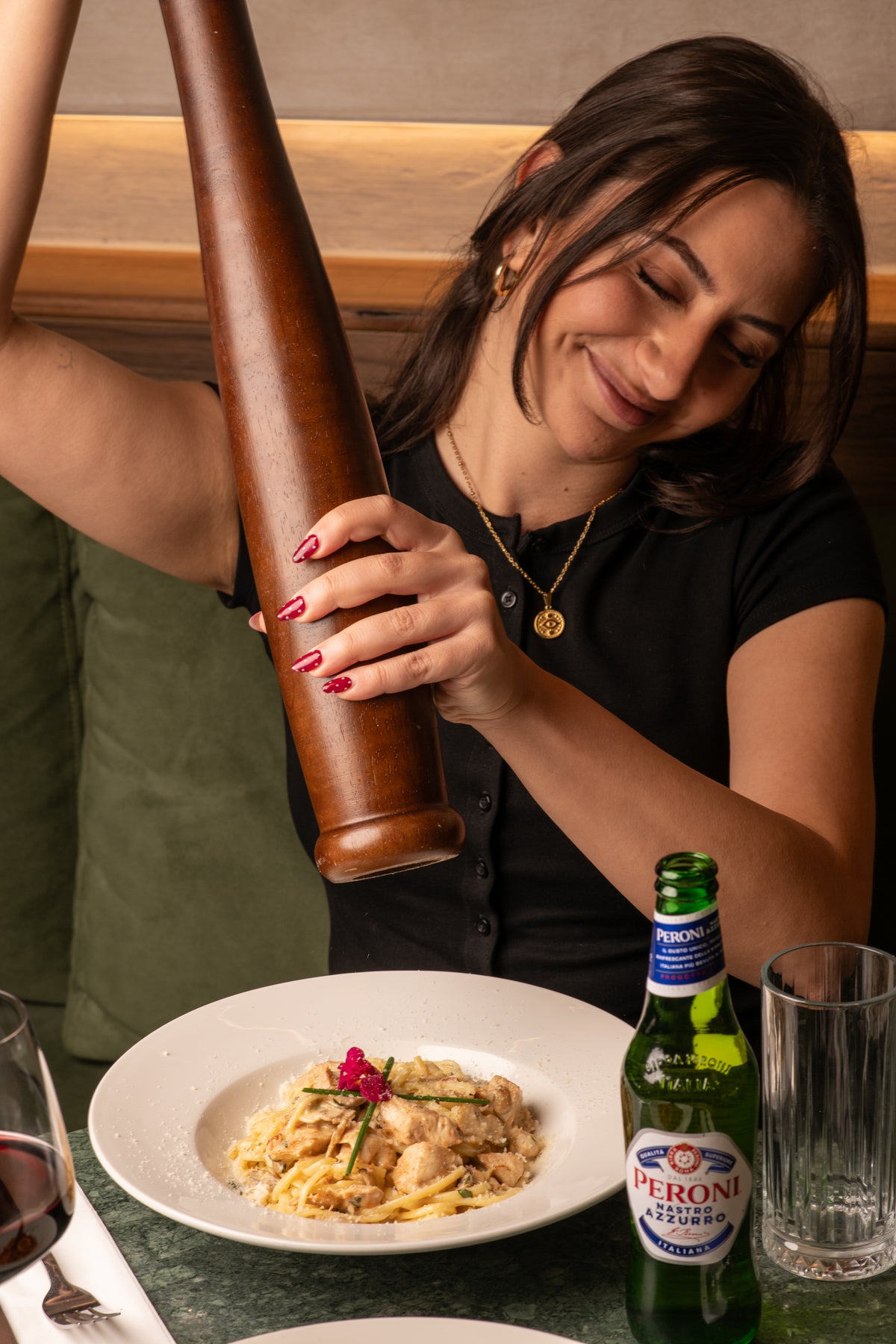
Coming as a group? Our group menu for five or more includes an Artisan spaghetti al pesto di pistacchio, with pesto, pistachios and buffalo mozzarella (it contains nuts), and the sharing Caprese comes with basil pesto too. See our posts on group dining and insalata caprese.
Ayub summed up our pasta: The pasta was perfectly al dente
(Ayub, Google review). And Fanghan wrote that The pasta and pizza were both delicious, and the portions were quite generous.
(Fanghan, Google review)
If you like the pesto, there's more meat-free pasta on the menu: the Ravioli ricotta & spinach in a sage and butter sauce, the vegan Penne arrabbiata with tomato, chilli and garlic, and the creamy Risotto mushrooms. Our posts on ravioli with sage butter, penne arrabbiata and vegetarian and vegan dining have the details.
Basil and cream like a fresh, crisp white. From our drinks menu, try the bone-dry Gavi di Gavi, with white blossom, lemon sherbet and green apple, the Vitis Nostra Grillo with crisp citrus, or a citrussy Pinot Grigio. Our guide to the wine list has more.
“guyssss you have to come here definitely! food is so daaaamn good”
Julia, Google review, 2026
Pounded, not stirred, from midday. Book a table or walk in at 4 Medway Court, Judd Street.
Red Lion Square is a small, leafy square just off Holborn, best known today as the home of Conway Hall. If you're there for a talk, a concert or a meeting an...
Read the storyDinner's done, the tiramisu is on its way, and someone asks for a brandy. If you've ever wondered what the letters on a Cognac bottle mean, or why Cognac is ...
Read the storyMost people know Chilean wine for Cabernet Sauvignon, Merlot or Carmenère. But for centuries, the grape that filled Chile's vineyards was a humbler one calle...
Read the story
